The winners were showcased in a new format, via a documentary film by director Dominik Mencej and director of photography Rok Kajzer Nagode.

Time and dialogue in architecture, architecture in time and in dialogue.
The presenting of Plečnik Awards is a singular ritual. With the grand revealing of the works of architectural excellence from recent years, it has taken place for 51 years, this year’s being the third time it is hosted in the garden of Plečnik House. The house and the garden are Plečnik’s most intimate spaces. Therein, the great architect’s creative and cognitive powers recombined in the notion of a home. Plečnik understood his home as a constant exercise in gradual annexation based on the permanent - perennial - notion of a house. In his thought and in his soul, he had harboured it twenty years before its realisation.
Plečnik Awards are presented to original works which, in one way or another, exhibit Plečnik’s ethos as they consider various contemporary societal challenges. This solemn ritual is more than just a testimony to the past; it is also a signpost directing our gaze into the future and emphasising the artistic, technical, and social responsibility in designing our shared space. Presenting the awards is an opportunity for the reflection upon the virtues of architecture in a dynamic environment facing numerous questions about the future our society and our environment. Going beyond the base standard, seeing beyond the economic and spatial barriers, seeking superior solutions, offering new visions and a consistent precision of execution are the tenets of any kind of developing, be it in the past, the present, or the future. This year’s awarded works are among those which take these premises to heart.
Many submitted works warranted careful consideration and would deserve a recognition or a nomination. Among the works in the running, the Jury wishes to showcase the renovation of the Ljubljana Castle casemates, the renovation of the Stara steklarska (Old Glassworks) in Ptuj, and the exemplary renovation of an office in Ferant’s Garden building in Ljubljana, all in the context of the dialogue with the heritage that each of them establishes. Among the new developments, the projects of the residential neighbourhood under Pekrska gorca in Maribor, the extension of factory TEM in Čatež, the swimming pool in Češča vas, and the semi-detached house in Murgle came closest in integrating the above principles. As regards the enrichment of spatial culture, the Jury draws attention to exhibitions KONS-TR3 and Searchings in Drawing, Findings in Thought – Fragments from the Legacy of Edvard Ravnikar, while the book series Teoretska praksa arhitekture (Theoretical Praxis of Architecture) is notable in publishing.
The majority of the submitted works belonged among small-scale realisations. The equality between the large and small scales is gaining in importance in the architectural practice. The Jury sees the said equality as part of the premise that in architecture, an idea has no scale.
As it discharged its duties, the Jury came again to the conclusion that time is one of the principal notions for architecture. Firstly, there is the time that we dedicate to the architectural work itself, its creation and execution. In this regard, it has been confirmed anew that the spatial experience is key for the comprehension and evaluation of architecture. The physical experience unveils the hidden qualities of the works, which reach beyond the codified norms and regular practices. Seeing something first-hand helps us recognise innovative solutions permeated with an artistic and spiritual impetus – solutions which engage us on a fundamental human level. In this way, inspirational spaces of empathy and humanity are laid open.
Yet we understood time also as a key context of architecture itself, one which oscillates between past scenarios and potential future ones; architecture which is embedded in a specific historical and cultural moment. Time is a process which enables us to perceive, explore, and comprehend architecture. And last but certainly not least, time also defines the relation to nature as a fluctuating and dynamic force.
This year’s Awards underscore a shift in the architectural discourse. Their area of interest are new approaches in considering the existing built and natural environment. These approaches develop in temporal strata and establish a dialogue which foregoes any pre-existing hierarchy in aligning the legacy of the past with the promise of the future. An approach of this kind is based on the principle of preservation which eschews the repetition of past states. Contemporary dialogue entwines new elements which are not only right for the purpose but elevate it, whereby the trace of a time emerges as the element of discovery that enhances the properties of an architectural work.
One of the unifying themes of this year’s awarded projects is dialogue. The recognised projects enter into diverse dialogues - with history, with forgotten anonymous built stock, and with the landscape. All of them, however, foster reflection and a respectful discussion among ourselves on the possibilities of reshaping our living environment.
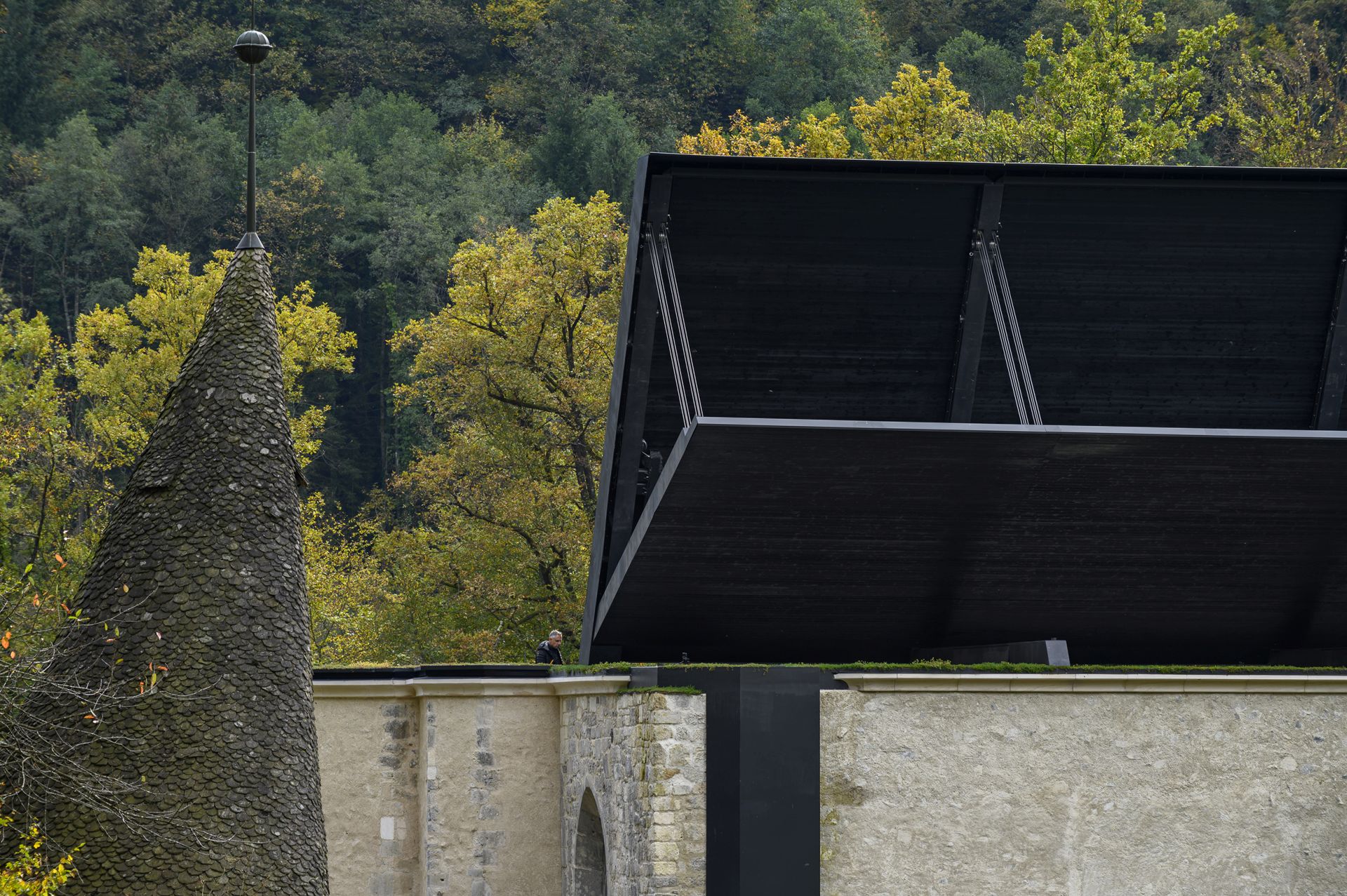
The covering of the remains of the Church of St John the Baptist in Charterhouse Žiče enters into a dialogue with the charterhouse’s past. The project is an example of architectural innovation and sensitivity in the fragile historical context. It aptly negotiates a path among the various options of the complex inclusion of contemporary interventions into the heart of the Carthusian monastery. Accommodating the various expert positions, the authors leverage the half-roof to successfully integrate two extreme and seemingly irreconcilable points. The solution inserts itself into the dialogue which transcends the physical presence of architecture and engages the place’s soul, as well as that of its observers’. The project is a testament to the exceptional capability of weaving a narrative that respects and glorifies its context’s historical, cultural, and emotional layers. It offers a glimpse of the power of the contemporary architectural language by means of creating a narrative befitting the emotionality and creativity of foregone eras. In the time of the pauperisation of the common space and the simplified intellectual horizons, it is an example of a committed professional and creative masterstroke.
Interventions into anonymous built fabric represent a new standing task of contemporary architecture, both in the wider social context as well as in the context of new possibilities of expression. In such projects, the dialogue is fundamentally different as anonymous architecture tends to lack the historical and architectural strata that would provide the author with underpinnings for the communication. In turn, contemporary architecture responds by furnishing solutions which form new contexts within existing building envelopes. The interventions by office Bevk Perović Arhitekti are an exemplary case of such considered and responsive design. In the National Center for the Comprehensive Rehabilitation of the Blind and Visually Impaired in Ljubljana, their approach to creating a »room within a room«, independent of architecture in which it is embedded, skilfully circumvents the conventional atmosphere of a hospital space and provides an environment which is functional and inviting at the same time. Their consistent execution ensures a stimulating environment on the path to rehabilitation for the users.
The proof that the context of anonymous architecture may be completely different is provided by the architects’ second awarded project. The preservation of industrial architectural elements – including those not enjoying heritage protection – in a design studio is a mark of the respect of existing structures. The architects presented both projects as a possible approach to reshaping the character of the previously existing; the recognition is thus extended to the approach itself. The footbridge in Irča vas is a dialogue with the landscape: it transcends the role of a structure; rather, it is a succession of spaces, sequences, and views – it’s a path that traverses a river so as to connect a forest and a town. Its elementary simplicity combines architecture, the necessities of statics, and the landscape. It is a marriage of poetics and engineering. Among the scores of infrastructures which bypass the co-operation with architects, the footbridge in Irča vas stands as a testament to the importance of an interdisciplinary approach to siting, design, and wider contextualisation of such structures.
The revealing of historical layers, the preservation of the existing, the establishment of new use for the future, architecture as a path and an action, the reading of the space, and the comprehension through motion: the role of time is inseparable from architecture and space, as well as from landscape. And it is precisely the latter that can’t be understood as a static, momentary image as it is always dependent on growth and decomposition. It is of winter, of spring, of the night, of the morning, it is barely established and a pre-landscape. The landscape and the garden unlock our view of the role of time in a space anew; as a result, the book Garden and Metaphor reinforces our comprehension of space.
Patience, reading, continuous education, and the broadening of knowledge in an inclusive dialogic manner is the foundation of the enrichment of spatial culture given that we have to understand it in order to accept and protect it. Meta Kutin has been doing all of the above already for a decade as part of the project Mesto živi v ljudeh (The City Lives within People). In doing that, she doesn’t merely add to the richness of the spatial culture but allows that which has already been established to become more widely recognised and accepted.
All the above topics are reflected in the submissions for the Plečnik Fund scholarship. Among them, there were master’s theses on the revitalisation of industrial buildings, works with comprehensive re-evaluations of the use of architectural heritage, and a theoretical work on the significance of nature and ruins. Neža Brankovič’s master’s thesis stresses the importance of reading, the discovery of social and historical strata, and a broad approach which – in its aim of understanding the meaning of an architecture before any intervention therein – leaves no detail unaddressed.
The 2024 Plečnik Awards Jury looked not just for the inclusion of current social and architectural issues in the recognised projects, but sought their transcending. It set out to find solutions that are inextricably embedded in the present yet use precisely that present point so as to consolidate the values of the past into a shared future. Architecture’s mission is to solve pressing spatial questions based both on a respectful attitude to the past as well as a vision of a better world of the future.
The Call for Applications for the 2024 Plečnik Awards received 45 proposals. From among those, 10 works were placed in the Large-Scale Architectural Realisations category, 14 works in the Small-Scale Architectural Realisations category, 5 works in the Public Space category, 3 works in Publication, 7 in the Spatial Culture Enrichment category, while 6 master’s theses were placed in the Plečnik Fund Scholarship category.
The Jury’s initial meeting took place on 30th January 2024 in Plečnik House, Ljubljana. Architect Matej Vozlič was chosen as Chair, and there was an initial review of all the works received. Until the following session, the members of the Jury reviewed the works individually and submitted their feedback on each of the works. On the 2nd session on 12th February 2024, the members of the Jury put forward their considered opinions and jointly drafted a selection of the works which exhibited outstanding qualities. The Jury viewed the twelve shortlisted works in two on-site visits, each lasting one full day. Upon each viewing, the members of the Jury put forward their considered opinions and comments on the respective works and discussed them.
After concluding the on-site views, the Jury re-classified one of the works submitted as a Large-Scale Architectural Realisation proposal as a Public Space work due to its public use and the inclusion of public open space as part of the project.
At two further sessions, on 28th February 2024 and 5th March 2024, the Jury was largely unanimous in choosing the Plečnik Medal winners in each of the categories. From among the selected works in the Large-Scale Architectural Realisation category, the Small-Scale Architectural Realisations category and the Public Space category, the Jury further chose the winner of the Plečnik Award.
2024 Plečnik Awards Jury
Matej Vozlič, predsednik
Blaž Babnik Romaniuk
Matjaž Bolčina
Luka Javornik
Mia Roth Čerina
The Call for Applications for the 2024 Plečnik Awards received 45 proposals. From among those, 10 works were placed in the Large-Scale Architectural Realisations category, 14 works in the Small-Scale Architectural Realisations category, 5 works in the Public Space category, 3 works in Publication, 7 in the Spatial Culture Enrichment category, while 6 master’s theses were placed in the Plečnik Fund Scholarship category.
The Jury’s initial meeting took place on 30th January 2024 in Plečnik House, Ljubljana. Architect Matej Vozlič was chosen as Chair, and there was an initial review of all the works received. Until the following session, the members of the Jury reviewed the works individually and submitted their feedback on each of the works. On the 2nd session on 12th February 2024, the members of the Jury put forward their considered opinions and jointly drafted a selection of the works which exhibited outstanding qualities. The Jury viewed the twelve shortlisted works in two on-site visits, each lasting one full day. Upon each viewing, the members of the Jury put forward their considered opinions and comments on the respective works and discussed them.
After concluding the on-site views, the Jury re-classified one of the works submitted as a Large-Scale Architectural Realisation proposal as a Public Space work due to its public use and the inclusion of public open space as part of the project.
At two further sessions, on 28th February 2024 and 5th March 2024, the Jury was largely unanimous in choosing the Plečnik Medal winners in each of the categories. From among the selected works in the Large-Scale Architectural Realisation category, the Small-Scale Architectural Realisations category and the Public Space category, the Jury further chose the winner of the Plečnik Awar
On Monday, May 20, 2024, the Jože Plečnik Fund held a ceremony to present the 2024 Plečnik Awards in the garden of the Plečnik House on Karunova Street in Ljubljana.
The awards were presented to the recipients in the pleasant and relaxed garden atmosphere of Plečnik House by the president of the jury, Matej Vozlič. The ceremony was graced by the presence of the keynote speaker, the President of the Republic of Slovenia, Dr. Nataša Pirc Musar, who gave an inspiring and principled speech, followed by a stage greeting from the former deputy mayor of Ljubljana, Prof. Janez Koželj, with his always inspiring words. The event was hosted by Timon Šturbej in the intimate and friendly atmosphere of a May evening. Prof. Boštjan Vuga, President of the Board of Directors of the Jože Plečnik Fund, addressed the guests and award winners with the following words: "The mission of the Plečnik Awards is to be forward-looking, to show the way forward and, with their excellence, uniqueness, and inventiveness, to influence the work of architects and the development of a wide range of architectural practices. The Plečnik Awards are given for completed, realized works. Here, the past and the present come together to provide material for the future. This is the significance of the Plečnik Awards, in their influence on architectural practices and future production. Today, the fund awards prizes to works that combine artistic imagination with contemporary social, political, economic, technological, and environmental developments and that demonstrate that their authors are not only active creators of space but of society as a whole.
The award ceremony opened with an introductory presentation of last year's scholarship recipients' projects, followed by the formal presentation of awards for the most outstanding realized architecture. This year's award winners were also presented in film format through a documentary by director Dominik Mencej and director of photography Rok Kajzer Nagode. The two-day program of awards, exhibitions, and round tables took place at three locations: Plečnik House, the atrium of the City Museum, and the DESSA Gallery.
The expert jury consisted of Matej Vozlič (chairman), Blaž Babnik Romaniuk, Matjaž Bolčina, Luka Javornik, and Mia Roth Čerina selected one Plečnik Award, four Plečnik Medals, and one student scholarship in the award categories (for large-scale architectural realization, small-scale architectural realization, public space, professional journalism, and enrichment of spatial culture).
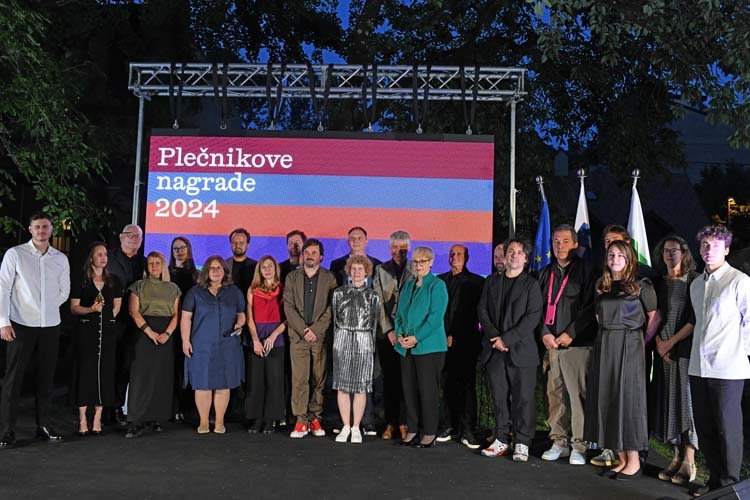
Foto: Mateja Jordovič Potočnik
The responsibility for the management and organisation of the 2024 Plečnik Award call for submissions and award ceremony was assumed by Boštjan Vuga and Urša Vrhunc on behalf of the Fund.
The event was made possible through kind support from: Ministry of Culture of the Republic of Slovenia, Ministry of Natural Resources and Spatial Planning of the Republic of Slovenia, City Municipality of Ljubljana, Arcadia Lightwear, Corwin, Tosidos, and Riko.